


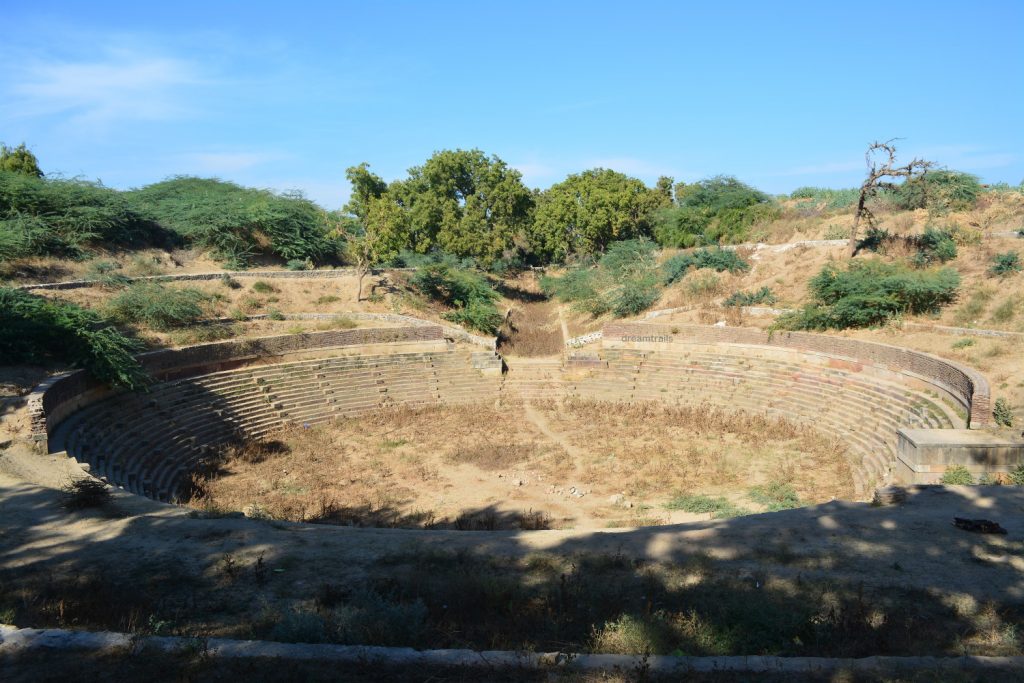
While Rani Ki Vav attracts visitors from around the world, very few continue just a kilometre further to discover Sahasralinga Talav. At first glance, it may appear to be little more than the remains of an ancient reservoir. But beneath these ruins lies one of the most ambitious hydraulic engineering projects built in medieval India.
Constructed during the reign of King Siddharaj Jaisinh of the Solanki dynasty in the 12th century, Sahasralinga Talav was far more than a lake. It was an enormous water conservation system designed to collect, filter and distribute water across the dry plains of Patan.


The name Sahasralinga literally means “a thousand Shiva Lingas.” According to historical records, hundreds of shrines dedicated to Lord Shiva once lined the reservoir, transforming an engineering project into a sacred place of worship. By combining water management with religion, the rulers encouraged people to respect and preserve one of the region’s most precious resources.
Although the reservoir no longer holds water, walking through its remains offers a fascinating glimpse into the remarkable planning and engineering skills of the Solanki era.

Not to Be Confused with Sahasralinga near Sirsi
One point that often confuses travellers is the similarity in the names. Sahasralinga Talav in Patan, Gujarat is a medieval reservoir built by the Solanki rulers as an advanced water conservation system. It is completely different from Sahasralinga near Sirsi in Karnataka, where thousands of Shiva Lingas are naturally carved into the rocks of the Shalmala River. While both sites derive their names from the presence of numerous Shiva Lingas, they are unrelated monuments located nearly 1,600 km apart and offer entirely different travel experiences.
If you’re planning a trip to Karnataka, don’t miss my detailed guide to Sahasralinga near Sirsi, one of the state’s most unique river-side heritage sites.
History of Sahasralinga Talav
Sahasralinga Talav was commissioned by King Siddharaj Jaisinh (also known as Siddharaj Jaysinh), one of the greatest rulers of the Solanki dynasty.
The reservoir was built by expanding an earlier lake known as Durlabh Sarovar, which had existed during the reign of King Durlabhraj. Engineers diverted water from the Saraswati River through an elaborate network of channels, allowing the reservoir to store water throughout the year.

The project served several purposes:
- supplying water to Patan,
- supporting agriculture,
- reducing the impact of drought,
- and creating a sacred space dedicated to Lord Shiva.
Historical accounts suggest that numerous shrines and lingas were constructed around the water channels, giving rise to the name Sahasralinga Talav.
Like many monuments of Gujarat, the reservoir suffered repeated destruction during invasions over the centuries. Much of the structure was buried beneath layers of soil before being excavated during archaeological work in the twentieth century.
Today, visitors see only a fraction of what once existed, but even these remains demonstrate the remarkable scale of the original project.
Architecture of Sahasralinga Talav
Unlike a natural lake, Sahasralinga Talav was carefully engineered to regulate the flow and storage of water.
The site covers a vast area, with interconnected channels directing water into the main reservoir. Stone steps descend into the channels, allowing people to access water even when levels were low.
Walking around the site, you’ll notice rows of carved pillars standing beside the channels. Some still support fragments of the original stone roof, while others display beautifully carved sculptures of Hindu deities.

The water channels weave through the complex before finally reaching the central storage area. Today this circular depression resembles a giant amphitheatre, but centuries ago it functioned as the heart of the reservoir.
What makes the site particularly impressive is that every element—from the channels to the steps and reservoirs—was designed to manage water efficiently long before modern engineering techniques existed.
The Legend of Jasma Odan
Like many historical monuments in Gujarat, Sahasralinga Talav is closely associated with a local legend.
According to folklore, Jasma Odan, a woman belonging to the Oad community of well diggers, was working on the construction of the reservoir. King Siddharaj Jaisinh became captivated by her beauty and wished to marry her.
Jasma rejected the proposal and remained loyal to her husband. Fearing that the king would force her into marriage, she chose death over dishonour and, before dying, cursed the king.
Her curse declared that:
- the king would never have an heir, and
- the magnificent reservoir would never remain filled with water.
Legend says the curse came true.

Later, to lift the curse, the king was advised that a man possessing thirty-two auspicious qualities must sacrifice himself for the welfare of society. A man named Mayo willingly offered his life, and a memorial temple was built in his honour near the reservoir.
While historians consider this a legend rather than established history, the story continues to form an important part of the cultural identity of Sahasralinga Talav.
What to See at Sahasralinga Talav
Although the reservoir no longer contains water, there is still plenty to explore.
Highlights include:
- Ancient stone water channels
- Rows of carved pillars
- Sculptures of Hindu deities
- The circular central reservoir
- Archaeological remains of medieval hydraulic engineering
- Mayo Memorial Temple nearby

The site is peaceful and receives far fewer visitors than nearby Rani Ki Vav, making it an enjoyable stop for travellers interested in history and archaeology.
Timings, Entry Fee & Visitor Information
| Information | Details |
|---|---|
| Timings | Sunrise to Sunset |
| Entry Fee | Free |
| Time Required | 30–45 minutes |
| Photography | Allowed |
| Best Combined With | Rani Ki Vav & Modhera Sun Temple |
Best Time to Visit
The ideal time to visit Sahasralinga Talav is between October and March, when Gujarat experiences pleasant weather.
Since the site is largely open without much shade, visiting early in the morning or late afternoon is more comfortable.

Distance from Nearby Places
| Destination | Distance |
|---|---|
| Rani Ki Vav | 1 km |
| Patan Bus Stand | 3 km |
| Modhera Sun Temple | 35 km |
| Ahmedabad | 130 km |
| Gandhinagar | 120 km |
Nearby Places to Visit
Rani Ki Vav
Just a kilometre away, this UNESCO World Heritage Site is one of India’s finest stepwells and the most famous attraction in Patan.
Modhera Sun Temple
Located about 35 km away, Modhera Sun Temple is celebrated for its magnificent Surya Kund, intricate carvings, and remarkable astronomical alignment.
Patan
The historic capital of the Solanki dynasty is also famous for its Patola silk weaving tradition, one of India’s oldest and most intricate textile crafts.
Suggested Day Trip from Ahmedabad
One of the best heritage circuits from Ahmedabad includes:
Ahmedabad → Adalaj Stepwell → Modhera Sun Temple → Rani Ki Vav → Sahasralinga Talav → Ahmedabad
This full-day journey showcases some of Gujarat’s finest examples of medieval architecture, engineering, and water management.
Travel Tips
- Combine the visit with Rani Ki Vav rather than travelling separately.
- Carry water and a cap, as there is little shade.
- Wear comfortable footwear for walking around the archaeological site.
- Visit during winter for the most pleasant experience.
- Don’t expect a lake—the attraction lies in understanding its historical engineering rather than seeing water.
