
Kalo Dungar — Standing Above the Endless Rann
There are places in Kutch that impress you with their beauty — and then there are places that quietly overwhelm you. Kalo Dungar, the Black Hill, belongs firmly to the second kind.

Rising to 462 meters (1,515 ft) above sea level, Kalo Dungar is the highest point in the Kutch region, standing like a natural balcony overlooking the vast emptiness of the Great Rann of Kutch. After driving for hours through flat, rugged terrain, the sudden climb toward this hill feels almost unexpected — as if the land itself decided to lift you up just to reveal its greatest secret.

And when you finally reach the top, the view explains everything.

The Rann stretches endlessly in every direction — silent, immense, and hypnotic. On clear days, the horizon dissolves into a soft blur where earth and sky merge seamlessly. The shimmering flats often resemble a giant lake, reflecting shades of blue and silver, making you momentarily question what is real and what is illusion.

It is not just a view. It is a feeling of standing at the edge of infinity.
Viewpoints That Slow Time
At the summit lies the popular Sunset Point, marked by a watchtower built to give visitors shade from the relentless Kutch sun. After the long drive, this becomes the perfect place to pause — to sit quietly, sip water, and simply absorb the stillness around you.

But the magic of Kalo Dungar isn’t limited to a single viewpoint. Walk a little farther, wander along the edges of the hill, and new perspectives keep appearing. Each angle reveals a slightly different mood of the Rann — sometimes pale and dreamy, sometimes sharply defined, sometimes glowing under shifting light.

The wind carries almost no sound here. No city noise, no crowds — just vast open space and the occasional call of birds circling far below. It’s the kind of silence that makes you slow down without realizing it.

The Hill of Legends and Living Traditions
Kalo Dungar is not only about landscapes — it is also a place where mythology quietly blends into everyday life. At the top stands a 400-year-old temple dedicated to Lord Dattatreya, believed to embody the divine trinity of Brahma, Vishnu, and Shiva.
What makes this temple truly unique is a ritual unlike any other.
Every day, boiled rice prepared as prasad is first offered not to devotees — but to jackals from the surrounding forests.
And the astonishing part? The jackals actually come.
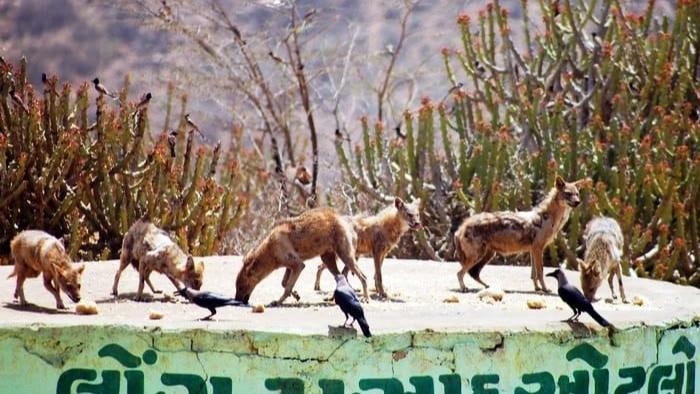
According to local legend, a devoted ascetic once performed penance here. To test his compassion, Lord Dattatreya appeared in the form of hungry jackals. The devotee had nothing but boiled rice to offer. When the animals refused, he selflessly offered flesh from his own body, uttering the words “Le Ang” — meaning “take my body.” Moved by such devotion, the deity blessed him, and the ritual of feeding jackals began.
Even today, temple priests call out a phrase derived from those same words — now pronounced “Long” — inviting the animals for their meal.
Another legend tells that Lord Dattatreya himself fed starving jackals by offering parts of his own regenerating body. Whether myth or faith, the tradition continues unchanged for centuries. Locals say only a few jackals appear during daytime offerings, but after sunset, groups sometimes gather quietly near the temple, waiting for their share.
Watching this ritual unfold feels surreal — a rare moment where folklore, faith, and wildlife coexist naturally.
When the Sun Sets Over the Rann
If there is one moment you should never rush at Kalo Dungar, it is sunset.

As evening approaches, the Rann begins its quiet transformation. The pale landscape slowly absorbs shades of gold and orange, and the sky deepens into warm hues. The sun descends gently, reflected faintly across the flats, turning the entire horizon into a glowing canvas.

For about twenty minutes, everything feels suspended in time.

Conversations grow softer. Cameras click less frequently. People simply stand still — watching the day fade away over one of the most unusual landscapes in India.

And when the sun finally disappears, the silence returns, deeper than before.

The Journey to Kalo Dungar
Reaching Kalo Dungar is part of the experience itself.
The hill lies about 90 km from Bhuj, and the most convenient way to visit is by hiring a taxi or riding a bike. The road takes you toward the White Rann through the village of Khavda, after which the landscape becomes increasingly remote and dramatic.
The highway eventually leads toward the India–Pakistan border, stopping near the army checkpoint at India Bridge, beyond which civilian movement is restricted. About 10 km before the bridge, a narrow road branches off toward Kalo Dungar.

The final climb is steep and winding, sometimes barely wide enough for two vehicles to pass — and during peak season, small traffic jams are common. But as the elevation increases and the Rann begins to appear below, every turn of the road builds anticipation.
By the time you reach the top, the journey feels completely worth it.
Travel Tip from Experience
Plan your visit so that you reach Kalo Dungar by late afternoon. This allows enough time to explore the viewpoints, visit the temple, witness the unique rituals, and stay back for the unforgettable sunset — the moment when Kalo Dungar truly reveals why it is one of Kutch’s most magical places.
Places to Visit Nearby
While visiting Kalo Dungar, you can explore some of the most iconic attractions in the Kutch region.
White Rann of Kutch
A short drive from Kalo Dungar takes you to the stunning White Rann of Kutch, known for its vast salt desert and unique landscape. This is one of the most popular destinations in Gujarat, especially during the winter months when the region hosts cultural events and attracts visitors from across the country.
The White Rann is often visited along with Kalo Dungar as part of the same trip.
Lakhpat
If you wish to explore further, Lakhpat lies towards the western edge of Kutch. This historic fortified town is known for its massive walls, quiet surroundings, and unique location near the border.
Once an important port town, Lakhpat today offers a peaceful and offbeat experience. It is often included in extended itineraries along with Kalo Dungar and the White Rann.

Social Presence!