


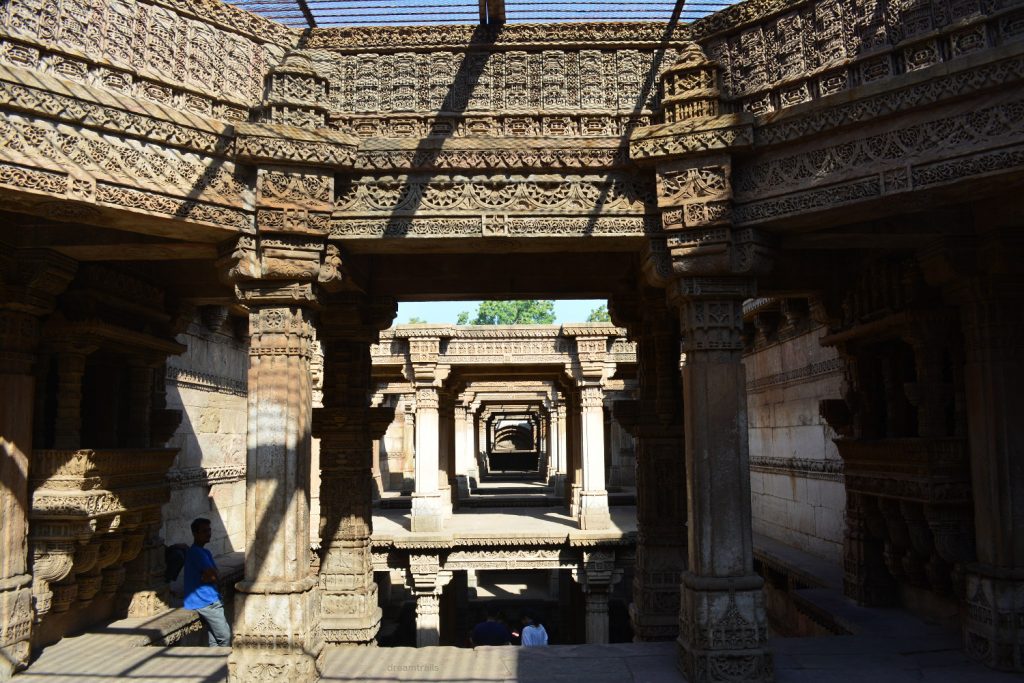
Located about 18 km from Ahmedabad and just outside Gandhinagar, Adalaj Stepwell is one of the finest examples of stepwell architecture in India. Built in 1499, this magnificent five-storey structure is renowned for its intricate stone carvings, remarkable engineering, and fascinating legend surrounding Queen Rani Roopba.


Unlike ordinary wells, stepwells were designed to serve multiple purposes. They stored water throughout the year, provided relief from Gujarat’s scorching summer heat, and offered travellers a cool place to rest during long journeys. Today, Adalaj Stepwell is one of the most popular historical attractions near Ahmedabad and an excellent destination for history lovers, photographers, and architecture enthusiasts.
Why Visit Adalaj Stepwell?
Adalaj Stepwell is much more than an ancient water reservoir. It is a masterpiece of architecture that beautifully blends Hindu craftsmanship with Islamic design elements, making it one of the finest examples of Indo-Islamic architecture in Gujarat.
Reasons to visit include:
- One of India’s most beautiful stepwells
- Intricate stone carvings on every level
- Unique five-storey underground design
- Pleasant temperatures even during summer
- Fascinating legend of Queen Rani Roopba
- Excellent photography opportunities
- Easy half-day trip from Ahmedabad


Architecture of Adalaj Stepwell
Adalaj Stepwell is a remarkable example of how art, architecture, and engineering came together over five centuries ago. The structure extends five storeys below ground level, allowing people to access water even during dry seasons.
One of its most striking features is the octagonal opening at the top of the well. Sunlight enters through this opening and gradually filters down the lower levels, creating dramatic patterns of light and shadow throughout the day.
Visitors enter the stepwell through three separate staircases, each beginning from a different direction. These stairways converge one level below the ground before continuing as a single staircase towards the well.

Each floor contains beautifully carved pillars, galleries, resting platforms, and open pavilions where travellers once escaped the intense afternoon heat. Even today, the lower levels remain noticeably cooler than the outside temperature.
The carvings are equally impressive. The lower levels feature sculptures of Hindu deities, dancers, musicians, flowers, birds, and scenes from everyday life, while the upper sections display elegant floral and geometric motifs influenced by Islamic architecture. This harmonious blend of styles makes Adalaj Stepwell one of Gujarat’s finest architectural monuments.

History of Adalaj Stepwell
The history of Adalaj Stepwell is closely linked with one of Gujarat’s most famous legends.
Construction of the stepwell began around 1498 under Rana Veer Singh, the ruler of the small kingdom of Dandai Desh. As Adalaj lay on an important trade route, the king wanted to build a stepwell that would provide water and shelter to travellers crossing the dry region.
Before construction could be completed, the neighbouring ruler Sultan Mahmud Begada attacked the kingdom. Rana Veer Singh was killed in battle, and the unfinished stepwell came under Begada’s control.
According to local legend, the widowed Queen Rani Roopba (Roodabai) wished to perform Sati after her husband’s death. Sultan Begada, impressed by her beauty, instead proposed marriage. The queen agreed on one condition—that he first complete the unfinished stepwell, fulfilling her late husband’s dream of helping the people.
After the monument was completed, Begada reminded the queen of her promise. Before the marriage could take place, Rani Roopba visited the completed stepwell, offered her prayers, and chose to end her life by jumping into the well rather than marry the conqueror.
While historians debate the exact details, this tragic legend has become inseparable from Adalaj Stepwell and continues to be narrated to visitors today.
It is also believed that Sultan Begada admired the monument so much that he ensured no identical structure would ever be built again, giving rise to another popular local legend associated with the master craftsmen who constructed it.

Why Were Stepwells Built?
Before modern water supply systems existed, stepwells played an essential role across western India, especially in the semi-arid regions of Gujarat and Rajasthan.
They served several important purposes:
- Stored rainwater throughout the year
- Provided drinking water during dry months
- Offered cool shelter for travellers
- Became gathering places for local communities
- Served as places for prayer and social interaction
Women often spent hours at these stepwells collecting water, offering prayers, and interacting with others in the village. The naturally cool environment also made them ideal resting places during the hot summer months.
Gujarat alone is believed to have hundreds of historic stepwells, with Adalaj Stepwell and Rani Ki Vav being among the finest surviving examples.
Photography at Adalaj Stepwell
Adalaj Stepwell is one of the most photogenic heritage monuments in Gujarat.
The changing light throughout the day creates beautiful patterns inside the monument, especially around the central octagonal opening. The symmetry of the staircases, intricately carved pillars, and repeating arches provide excellent opportunities for architectural photography.
Morning is generally the best time to visit, when the monument is less crowded and the softer light enhances the carvings.

Timings, Entry Fee & Visitor Information
| Information | Details |
|---|---|
| Timings | 8:00 AM – 6:00 PM (subject to change) |
| Entry Fee | Free |
| Time Required | 45 minutes to 1 hour |
| Best Time to Visit | October to March |
| Photography | Allowed |
How to Reach Adalaj Stepwell
From Ahmedabad
Adalaj Stepwell is approximately 18 km from Ahmedabad city and takes around 35–40 minutes by road. Taxis, app-based cabs, and private vehicles are the most convenient options.
From Gandhinagar
The monument is located about 5 km from Gandhinagar and can be reached within 10–15 minutes.
By Public Transport
State transport buses and shared auto-rickshaws frequently operate between Ahmedabad, Gandhinagar, and Adalaj.
Distance to Nearby Attractions
| Destination | Approximate Distance |
| Ahmedabad Railway Station | 18 km |
| Sardar Vallabhbhai Patel International Airport | 15 km |
| Gandhinagar | 5 km |
| Modhera Sun Temple | 85 km |
| Rani Ki Vav, Patan | 95 km |
| Sahasralinga Talav | 97 km |

One-Day Trip from Ahmedabad
Adalaj Stepwell can easily be combined with other heritage attractions for a memorable day trip.
Option 1 – Half-Day Heritage Tour
Ahmedabad → Adalaj Stepwell → Gandhinagar → Akshardham Temple
Option 2 – Full-Day Heritage Circuit
Ahmedabad → Modhera Sun Temple → Rani Ki Vav → Sahasralinga Talav
The second itinerary is perfect for travellers interested in Gujarat’s rich architectural heritage and can comfortably be completed with a private vehicle.
Travel Tips
- Visit early in the morning to avoid crowds.
- Wear comfortable footwear, as there are several flights of steps.
- The lower levels remain significantly cooler than outside temperatures.
- Spend time observing the intricate carvings on each level rather than rushing directly to the bottom.
- Carry water during summer, although the monument itself remains pleasantly cool.
Nearby Places to Visit
Rani Ki Vav
A UNESCO World Heritage Site in Patan, Rani Ki Vav is regarded as the finest stepwell in India, famous for its extraordinary sculptures and intricate craftsmanship.
Modhera Sun Temple
Dedicated to the Sun God, this 11th-century temple is one of Gujarat’s greatest architectural masterpieces and is renowned for its magnificent Surya Kund.
Sahasralinga Talav
Located near Patan, Sahasralinga Talav is a historic medieval water reservoir associated with the Solanki dynasty and an important archaeological site.
Ahmedabad
The vibrant city of Ahmedabad offers numerous attractions, including heritage walks, Sabarmati Ashram, bustling markets, and excellent Gujarati cuisine, making it an ideal base for exploring the region.
