


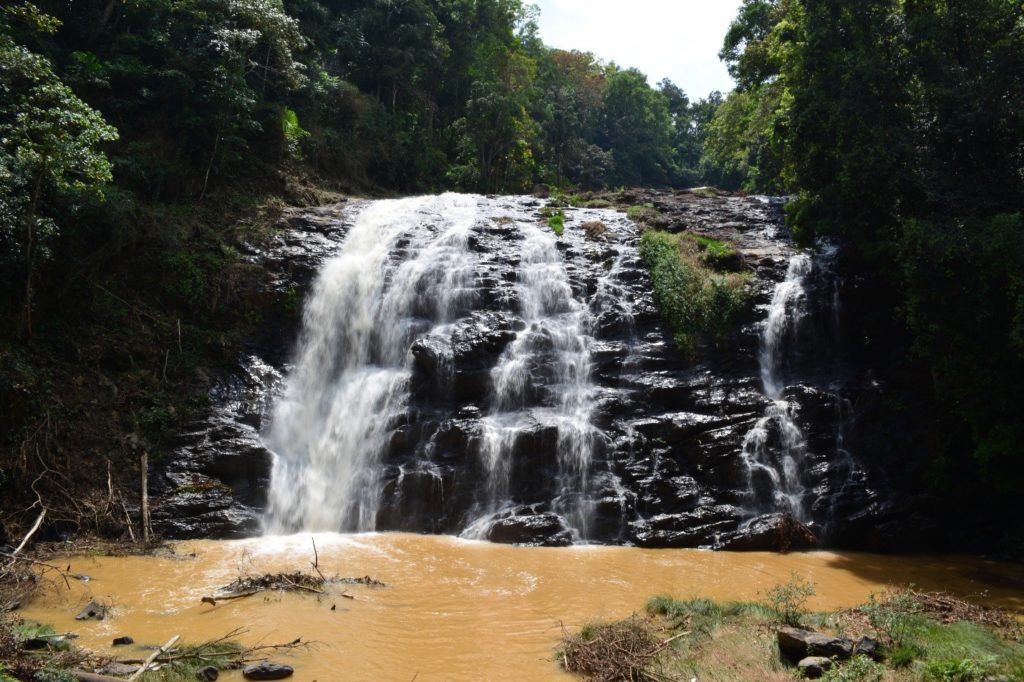
Abbey Falls is one of the most popular waterfalls to visit around Madikeri in Coorg (Kodagu), Karnataka. The waterfall is surrounded by lush greenery and coffee plantations, and the short walk through the plantation to reach the falls is part of the experience.
The waterfall is formed by a stream that eventually joins the River Cauvery, cascading down a rocky gorge in two visible stages. During the monsoon and the months that follow, the volume of water increases considerably, turning Abbey Falls into an impressive spectacle of rushing water, mist and sound.
Unlike some waterfalls where the main attraction is getting into the water, Abbey Falls is primarily a viewing experience. Visitors are kept behind safety barriers around the waterfall, and swimming or bathing is not permitted. A hanging bridge across the stream provides one of the best vantage points to see the falls.


Abbey Falls and the Surrounding Coffee Plantations
One of the things I particularly like about visiting Abbey Falls is that the experience begins well before you actually see the waterfall.
The entrance is surrounded by the characteristic greenery of Coorg, and the walk towards the falls takes you through a plantation landscape. Coffee is one of the most important crops in Kodagu, and depending on the season, you may also see other plants growing around the estate.
As you walk deeper into the plantation, the sound of the waterfall gradually becomes louder. At first, you hear the water long before you can see it. A little further along, the trees open up and the waterfall suddenly appears through the greenery.
The contrast between the relatively quiet plantation trail and the powerful sound of the falling water makes the first view of Abbey Falls quite memorable.
What Does Abbey Falls Look Like?
Abbey Falls drops through a rocky, heavily forested gorge, with water rushing down the rocks before continuing downstream towards the Cauvery.
The waterfall is not one enormous vertical drop. Instead, the water cascades down in stages, creating a broad and constantly changing appearance depending on the season and water flow.
During the dry months, the flow can be considerably lower. After the monsoon, however, the waterfall can become much more dramatic, with a large volume of water rushing over the rocks and producing a deafening roar.
This seasonal variation is one reason the time of year makes a significant difference to an Abbey Falls visit.
The Hanging Bridge and View of the Falls
A hanging bridge has been built across the stream near the waterfall. It offers a different perspective of Abbey Falls and is one of the most recognizable features of the attraction.
The bridge and the surrounding viewing areas also serve an important purpose: they allow visitors to get a good view of the waterfall without approaching the dangerous sections of the gorge.
You cannot walk down to the base of the waterfall or enter the water around the falls. Safety barriers have been installed around the main viewing areas, and visitors are expected to remain within the designated sections.


Is Abbey Falls Worth Visiting?
If you’re already exploring Madikeri and central Coorg, I think Abbey Falls is worth including, particularly when the waterfall is carrying plenty of water.
It isn’t a place where you need to spend half a day. The actual waterfall visit is relatively short, but the combination of the plantation walk, the waterfall and the surrounding greenery makes it a pleasant stop on a Coorg sightseeing itinerary.
And if you’re expecting a place where you can swim, picnic beside the waterfall or explore the rocks around its base, Abbey Falls may not be what you’re looking for. It is better approached as a scenic waterfall viewpoint rather than an adventure or bathing destination.
For me, its biggest attraction is simple: a powerful waterfall hidden inside the green landscape of Coorg, reached by a short walk through a coffee-growing region.
How to Reach Abbey Falls
Abbey Falls is located close to Madikeri, making it one of the easier waterfalls to include in a Coorg itinerary. The falls about 6-8 km from Madikeri town, depending on where in Madikeri you start.
If you are staying in Madikeri, the simplest option is to drive or take a taxi towards Abbey Falls. Once you reach the entrance, there is a dedicated parking area, although parking is limited, particularly when the attraction is busy.
The final approach takes you away from the main road and into the plantation landscape. From the entrance, you walk through the coffee plantation towards the waterfall.
The Walk to Abbey Falls
The walk from the entrance to the waterfall is short. The current route includes a paved path and steps through the plantation, making Abbey Falls accessible even for casual travellers and families.
It isn’t a trek in the conventional sense. You don’t need trekking experience or special equipment to reach the viewpoint.
That said, the surroundings can become wet and slippery during the monsoon, so proper footwear is a much better idea than trying to negotiate the steps in sandals or smooth-soled footwear.
And don’t rush through the walk.
The coffee and spice plantations are an important part of what makes the approach to Abbey Falls enjoyable. You may hear the waterfall before you actually get a clear view of it, with the sound gradually becoming louder as you descend towards the gorge.

Abbey Falls Viewpoint
At the end of the path, the waterfall comes into view from across the gorge.
A hanging bridge provides the main vantage point, allowing visitors to look directly towards the cascading water from above. The waterfall drops approximately 70 feet over the rocks, and the broad cascade makes quite an impressive sight when the water level is high.
The viewpoint is also the reason you should not expect the kind of waterfall experience where you climb over rocks and stand underneath the falling water.
The gorge is dangerous, particularly when the river is carrying a lot of water, and access to the water is restricted.
Can You Swim or Bathe at Abbey Falls?
No. Swimming and bathing are not permitted at Abbey Falls.
Safety barriers keep visitors away from the dangerous sections around the waterfall, and the water should not be entered even if you see photographs from older visits showing people near or in the water.
This is worth knowing before you visit because Abbey Falls is sometimes described online as though it were a natural swimming hole.
It isn’t.
Think of Abbey Falls as a waterfall viewpoint surrounded by coffee plantations, rather than a place for getting into the water.
Abbey Falls Timings
Abbey Falls is open from 9 AM to 5 PM, though I recommend checking the latest local information before setting out, particularly if you’re visiting during the monsoon or after periods of heavy rain.
If you’re visiting primarily for photography, morning is a good time to arrive. Besides giving you better light, an early visit can help you avoid some of the crowds that arrive later in the day.
How Long Do You Need at Abbey Falls?
You don’t need an entire day for Abbey Falls.
For most visitors, around 1–2 hours is enough to walk through the plantation, spend some time at the waterfall viewpoint and return to the entrance.
The actual waterfall viewing is relatively quick, but you may want to spend longer if you’re interested in photography or simply want to enjoy the plantation surroundings.
This is also why Abbey Falls works particularly well as a short stop during a day of sightseeing around Madikeri, rather than as the sole destination for the day.
When Is the Best Time to Visit Abbey Falls?
The best time to visit Abbey Falls depends on what you want from the experience.
If your priority is seeing the waterfall at its most powerful, plan your visit during the monsoon and the months immediately afterwards (July to December), with the falls particularly impressive during and after the monsoon.
The difference can be quite dramatic. During the rainy season, the streams feeding the waterfall carry much more water, turning Abbey Falls into a broad, roaring cascade. The surrounding coffee and spice plantations are also at their greenest, making the entire approach to the waterfall more scenic.
If, however, you prefer more comfortable weather and easier sightseeing, the post-monsoon and winter months are a better compromise.
Abbey Falls During the Monsoon
July to September is when Abbey Falls is at its most dramatic.
Heavy monsoon rains feed the streams around Madikeri, and the waterfall can turn into a powerful torrent. The surrounding plantations become intensely green, and mist and rain add to the atmosphere.
This is arguably the most spectacular time to photograph Abbey Falls.
But there is a trade-off. The path and steps can become wet and slippery, and the area can be crowded during weekends and holidays. Heavy rain can also make driving around the hill roads less comfortable.
So if you visit during the monsoon:
- Wear shoes with good grip.
- Carry a rain jacket or umbrella.
- Keep your camera and phone protected from rain and spray.
- Be particularly careful on wet steps.
- Don’t attempt to enter the water.
- Check local weather and road conditions if heavy rain is forecast.
Coorg itself receives substantial rainfall during the southwest monsoon. It is advisable to carry appropriate rain protection and take care on forested and hilly routes during this period.
October to December: My Preferred Window
If you want a good combination of water flow, greenery and relatively comfortable weather, I’d consider October to December an excellent period for Abbey Falls.
The landscape is still lush after the monsoon, while the weather generally becomes more pleasant as the rains recede. The waterfall can continue to carry substantial water, particularly in the earlier part of this period.
This is also a good period if Abbey Falls is part of a larger Coorg itinerary. You can combine the waterfall with other attractions around Madikeri without having to plan your entire day around heavy rain.
What About the Rest of the Year?
Abbey Falls can be visited outside the monsoon as well.
From January to May, the weather is generally more predictable and the plantation surroundings remain attractive, but the waterfall’s flow can be considerably lower than during the rainy season.
That doesn’t mean it isn’t worth visiting.
The waterfall is still a scenic stop, particularly if you’re already exploring Madikeri. Just don’t expect the enormous volume of water you may have seen in photographs taken during the monsoon.
In other words:
Visit during the monsoon if the waterfall itself is the main attraction. Visit during the drier months if Abbey Falls is one stop among several on your Coorg itinerary.
Abbey Falls in a Coorg Itinerary
Abbey Falls is close enough to Madikeri that it is easy to combine with several other attractions in and around Coorg. In fact, I would recommend doing that rather than planning an entire day just for the waterfall.
The easiest combination is with the attractions around Madikeri.
Abbey Falls + Raja’s Seat
If you are staying in Madikeri, Raja’s Seat is perhaps the most natural attraction to combine with Abbey Falls.
Abbey Falls is about 6–9 km from Madikeri, depending on the starting point and the route, while Raja’s Seat is within Madikeri itself.
You could visit Abbey Falls in the morning and return to Madikeri for lunch before spending the evening at Raja’s Seat.
This combination works particularly well because the two attractions offer completely different experiences: Abbey Falls gives you a waterfall surrounded by coffee and spice plantations, while Raja’s Seat is primarily about the panoramic valley views.
Abbey Falls + Dubare Elephant Camp
If you have a full day available, you can extend the itinerary towards Dubare Elephant Camp.
Dubare is approximately 40 km from Abbey Falls, making the two attractions feasible to combine in a single day if you plan your timings carefully.
However, there is an important consideration: Dubare is better visited early in the day because its elephant-related activities are concentrated in the morning.
So I wouldn’t necessarily recommend:
Abbey Falls → Dubare
as your default order.
If Dubare is one of your priorities, visit Dubare first and Abbey Falls later. If Abbey Falls is your priority, you can do the reverse and accept that you may reach Dubare after some of its morning activities.
This is also one reason why I wouldn’t try to squeeze every Coorg attraction into a single day.
Abbey Falls + Cauvery Nisargadhama + Bylakuppe
Another useful combination takes you towards Kushalnagar.
From Abbey Falls, Kaveri Nisargadhama is at an approximate distance of 31 km and Golden Temple at Bylakuppe is 38 km.
These three attractions can therefore form a logical circuit:
Abbey Falls → Bylakuppe Golden Temple → Kaveri Nisargadhama
or, depending on your starting point:
Madikeri → Abbey Falls → Bylakuppe → Nisargadhama → Kushalnagar
The latter works particularly well if you’re staying around Kushalnagar rather than returning to Madikeri.
And because Bylakuppe and Nisargadhama are relatively close to each other, they make a particularly sensible pair. The Kodagu district tourism site places Nisargadhama about 28 km from Madikeri, while it is only a short distance from Kushalnagar.
Abbey Falls + Talakaveri
You can also combine Abbey Falls with Talakaveri, although I would treat this as a longer day rather than a quick combination.
Talakaveri at roughly 50 km from Abbey Falls.
The two attractions are quite different, which makes the combination interesting: Abbey Falls is a short nature stop, while Talakaveri involves travelling deeper into the hills towards the source of the Cauvery.
If you want to visit both, I’d start early and allow plenty of time for the drive.
How I Would Plan Abbey Falls
If you are staying in Madikeri, I’d choose one of these approaches:
Easy half-day:
Madikeri → Abbey Falls → Madikeri → Raja’s Seat
Full day towards Kushalnagar:
Madikeri → Abbey Falls → Bylakuppe → Kaveri Nisargadhama → Kushalnagar
Full day with Dubare:
Madikeri → Dubare Elephant Camp → Kaveri Nisargadhama → Abbey Falls → Madikeri
Longer hill day:
Madikeri → Abbey Falls → Talakaveri → Bhagamandala → Madikeri
The exact order can be adjusted depending on opening hours, your accommodation and which attraction you consider the priority.
How Far Is Abbey Falls from Other Popular Coorg Attractions?
For quick itinerary planning, the distances are approximately:
| Attraction | Approx. distance from Abbey Falls |
|---|---|
| Madikeri | 6–9 km |
| Raja’s Seat | ~7 km |
| Kaveri Nisargadhama | ~31 km |
| Golden Temple, Bylakuppe | ~38 km |
| Dubare Elephant Camp | ~40 km |
| Talakaveri | ~50 km |