


The Rann of Kutch is a vast desert landscape spread across nearly 30,000 square kilometres in western India. While the western part is famous for the dazzling salt flats of the Great Rann of Kutch, the eastern region is known as the Little Rann of Kutch — a dry, barren desert with a massive salt bed beneath the ground.


Unlike the white salt desert of the Great Rann, this landscape is mostly dusty, cracked earth with occasional trees and seasonal wetlands. Despite its harsh environment, the Little Rann of Kutch is famous for its wildlife, migratory birds, and the endangered Indian Wild Ass.

Getting to Little Rann of Kutch
The Little Rann of Kutch lies about 100 km from Ahmedabad, making it a convenient weekend destination for travelers looking for a unique desert experience.
Several small resorts and eco-lodges are located around the desert edge, and most of them organize guided desert safaris as part of their stay packages.

Desert Safari Experience
A typical safari lasts around three hours and takes visitors deep into the dry desert landscape.

The first thing you notice is the vast cracked earth, covered by a thin layer of dark brown or black dust. The dryness of the land is caused by the extensive salt deposits beneath the surface, making the region unsuitable for agriculture.

Occasionally you may spot a few trees or small cotton fields near the edges of the desert, supported by irrigation canals dug by local farmers.

The Indian Wild Ass Sanctuary
One of the highlights of the safari is spotting the endangered Indian Wild Ass, locally known as Ghudkhur.


These shy animals roam freely across the desert and often move in herds. Even from a distance, they tend to run away quickly when vehicles approach.

The desert is part of the Indian Wild Ass Sanctuary, the last natural habitat of this species. Conservation efforts have helped increase their population in recent years, and thousands of wild asses now inhabit the region.

Birdlife in the Desert
As the safari moves deeper into the desert, the landscape slowly changes.

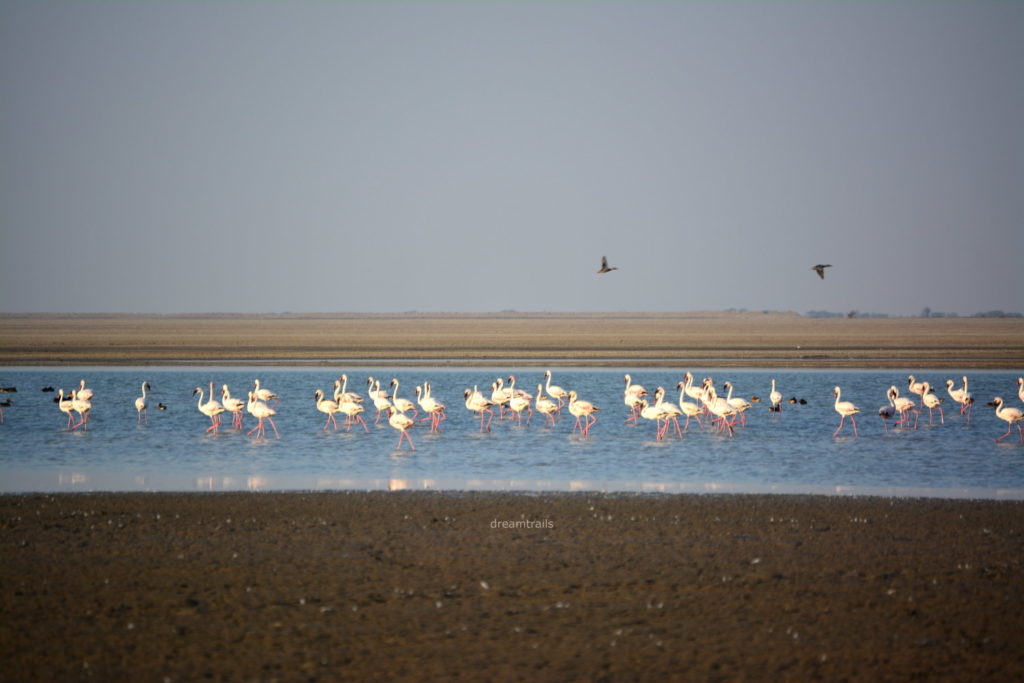
Suddenly, the dry land gives way to wetlands and shallow water bodies where migratory birds gather. Large flocks of flamingos, cranes, and other migratory birds can often be seen feeding in these seasonal lakes.

These wetlands form when small seasonal rivers flow into the desert and create temporary lakes, attracting birdlife from distant regions.

Salt Extraction in the Desert
Another fascinating sight in the Little Rann of Kutch is the traditional salt-making process.


Small huts scattered across the desert belong to families who extract salt from underground brine. Salt water from deep underground is pumped into shallow pools, where it evaporates under the intense sun.

The process is repeated through several stages until salt crystals form, which are then collected and sold for commercial use.

Life here is extremely harsh. Families live in isolation for months, often with minimal electricity and limited access to markets or towns.

Sunset in the Little Rann
As evening approaches, the desert transforms once again.

The setting sun casts warm golden colours across the cracked earth, creating a surreal and peaceful landscape. Watching the sunset in the middle of the silent desert is often the highlight of the entire safari.

Visiting the Little Rann of Kutch
If you are visiting the region, the Little Rann can easily be combined with a broader trip through the Kutch region of Gujarat, which includes destinations like the Great Rann of Kutch, the ancient archaeological site of Dholavira, the coastal town of Mandvi and the historic town of Bhuj.

The best time to visit is November to February, when the weather is cooler and birdlife is abundant.
Conclusion
Despite its harsh environment, the Little Rann of Kutch offers a surprisingly rich experience. From herds of wild asses and migratory birds to the traditional salt-making communities, the desert reveals a unique ecosystem and way of life.

For travelers around Ahmedabad, it makes for a memorable journey into one of Gujarat’s most unusual landscapes.